Feel confident every step of the way

What is the role of a realtor in Quebec (2026)
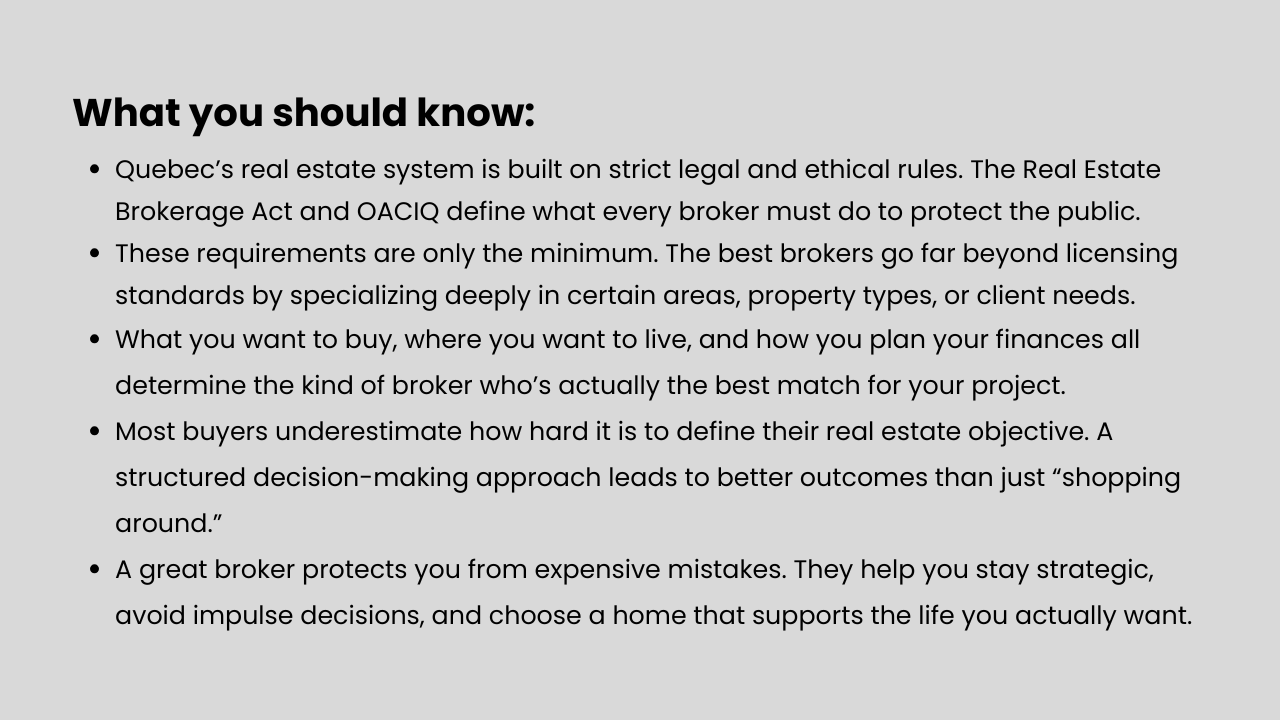
In Quebec, the role of a real estate broker is shaped by two major forces.
First, the legal and ethical framework mandated by the OACIQ and the Real Estate Brokerage Act. Second, market expectations, the services and standards that clients and industry norms demand.
Understanding both helps buyers and sellers know what a broker is required to do at a bare minimum and what the best brokers do differently. This enables you to know what to look for when comparing professionals.
In this article, we will break down:
- The legal and ethical framework (OACIQ + Real Estate Brokerage Act)
- Market expectations (what clients and industry norms demand)
- How to find the right broker for your project
The legal and ethical framework (OACIQ + Real Estate Brokerage Act)
The current Real Estate Brokerage Act (in Quebec, Loi sur le courtage immobilier) provides the legal foundation for how real estate brokers must conduct themselves. Its fundamental purpose is to protect the public during real estate transactions. It does this by setting out mandatory standards for practice. This includes duties like acting with honesty, competence, loyalty, and transparency when representing clients.
Arguably the most important thing that the Act did for the public was to create the OACIQ (Organisme
d’autoréglementation du courtage immobilier du Québec). This is a self regulatory organization (SRO) responsible for administering and enforcing the law.
The OACIQ fulfills this mandate by:
- Licensing and qualification oversight: Requiring all brokers to complete approved training, pass an exam, and meet ongoing education requirements before and while they practice.
- OACIQ Professional conduct and supervision: Setting and enforcing rules of professional conduct and ethical behaviour through regular inspections and compliance checks.
- OACIQ Public protection and dispute resolution: Offering complaint handling, investigation, discipline, and assistance to the public if a broker fails to meet their legal duties.
- OACIQ License control: Issuing, renewing, suspending, or revoking licences when brokers do not comply with the law or standards of practice.
The aim of the OACIQ license is that it ensures all brokers meet the basic legal and ethical standards set by the OACIQ. This framework creates a clear foundation for what brokers must do. For instance, brokers must act in their client’s best interests, use written contracts, protect confidential information, avoid conflicts of interest, and follow strict rules about what they can and cannot communicate on behalf of a client. They’re also required to make specific recommendations, for example, all brokers must recommend a pre-purchase inspection.
These obligations are essential, but they represent the minimum level of service expected from any licensed broker.
In practice, the best brokers in Montreal go far beyond this baseline. They specialize in certain neighbourhoods or property types, build deep market knowledge, develop strong professional networks, and tailor their approach to the specific needs and personalities of the clients they work with.
In short: the OACIQ provides the foundation for what the broker must do but, the best brokers raise the bar.
Market expectations (what clients and industry norms demand)
The best brokers in Montreal often specialize in specific client types, property categories, or project models. This allows them to build deep expertise and deliver far higher value for specific customer types. Some examples include brokers who focus on:
- First-time buyers
- Luxury homes
- Income properties and plexes
- New construction or presale projects
- Downsizers and families
- Rural or off-grid properties (e.g., homes without municipal water, sewer, or electricity)
- Specific neighbourhoods or micro-markets
- And so on.
For instance, did you know that the rules around cottage to plex conversion are different for almost every borough in Montreal? Or where to find the best retirement communities? Or what are the major risks that buying a detached house can represent to first time home buyers?
Depending on your goals, you should expect your broker to truly understand your needs and tailor their advice accordingly. A good broker will listen carefully, internalize your priorities, and help you build a realistic plan. Whether that’s a long-term path to multiple property ownership and wealth creation, or simply finding a home where you and your family will be happy for years to come.
Every client’s situation is different, and every broker has their own area of expertise. That’s why it’s important to work with a broker whose specialty matches your specific goals, property type, and market area. When your broker fits your needs, you gain not just guidance, but a partner who can help you navigate the complexities of Montreal’s real estate market with confidence.
So the real challenge is, first to identify your goals and second, to find the right broker for your project.
“If you can’t define what you’re wanting to do in the real estate business and you’re just going to take it as it comes to you, you’re just driving without a destination.” Ben Caballero, founder & CEO of HomesUSA.com, the top‑producing agent in the U.S.”
How to find the right broker for your project
It is actually much harder to decide what you want to do in real estate than people first realize. For instance many buyers think they simply want “a good deal” or “a nice home,” but once you dig in, there are some hard questions to answer:
- Are you trying to build long-term wealth, or minimize monthly payments?
- Do you want a home that fits your lifestyle today, or one that positions you for the next 5–10 years?
- Are you open to multi-unit properties, or is a single-family home non-negotiable?
- Do you prefer an established neighbourhood, or an area with future growth potential?
Your goals, risk tolerance, life stage, and financial strategy all shape the kind of project you should pursue and the kind of broker best equipped to guide you.
I use a structured decision-making approach similar to those studied in real estate research where defining your goals, understanding your constraints, and evaluating alternatives upfront leads to far better outcomes than going in without a plan. From there, I will tell you if I am the best person to work with you, or if someone in my professional network would be better placed to help you.
Once you know what you want to do, choosing a broker becomes much easier. Today, there are several broker-matching platforms that let you filter brokers by things like neighbourhood, experience, language, or property type.
But there are a few things to keep in mind.
There are more than 17,000 brokers in Quebec. From this list, many list themselves as active across broad areas, making it harder to identify who is truly specialized in your type of project. Furthermore, some broker matching platforms focus primarily on lead generation rather than matching clients with brokers who are the best fit for their needs.
This is where the newer broker-matching systems come in.
There are advanced broker-matching systems that use AI to analyze broker activity, specialization, and client fit. One of the newest platforms which incorporates a real decision-making framework, identifies which brokers are actually active in each area, and matches based on real client needs is called Immovision. They also publish a much more detailed guide explaining how their system works and how to choose the best realtor in Montreal for your project.
Final remarks
A home isn’t like a pair of shoes you return. It’s a multi-hundred-thousand-dollar, even million dollar decision, that locks in years of your life. Your finances, your routines, your stress levels, your commute are all influenced heavily by where your decisions on what home you buy or when you sell.
The role of a realtor is to help guide you through this process. This means not only following the OACIQ minimum requirements, but helping you navigate zoning, market trends, financing, renovations, city infrastructure projects and much more.
Real estate is complex, much more so than many people think. And the consequences of getting it wrong are high. But with the right guidance, it’s completely manageable.
For experienced realtors, reputation is everything. Every client I work with takes my name and puts it into Google before doing business with me. With that in mind, I won’t take on a new project if I’m not the right fit.
So, if you want a call, I will take the time to listen carefully to your goals, priorities, and concerns. Together, we’ll map out a plan that fits your needs, your timeline, and your financial strategy. And if I’m not the ideal fit for your project, I’ll connect you with someone in my professional network who is.
And if not, that’s fine as well. Thank you for reading this article, I hope that you got some value out of it.
Your friendly realtor,
Reda Wahba